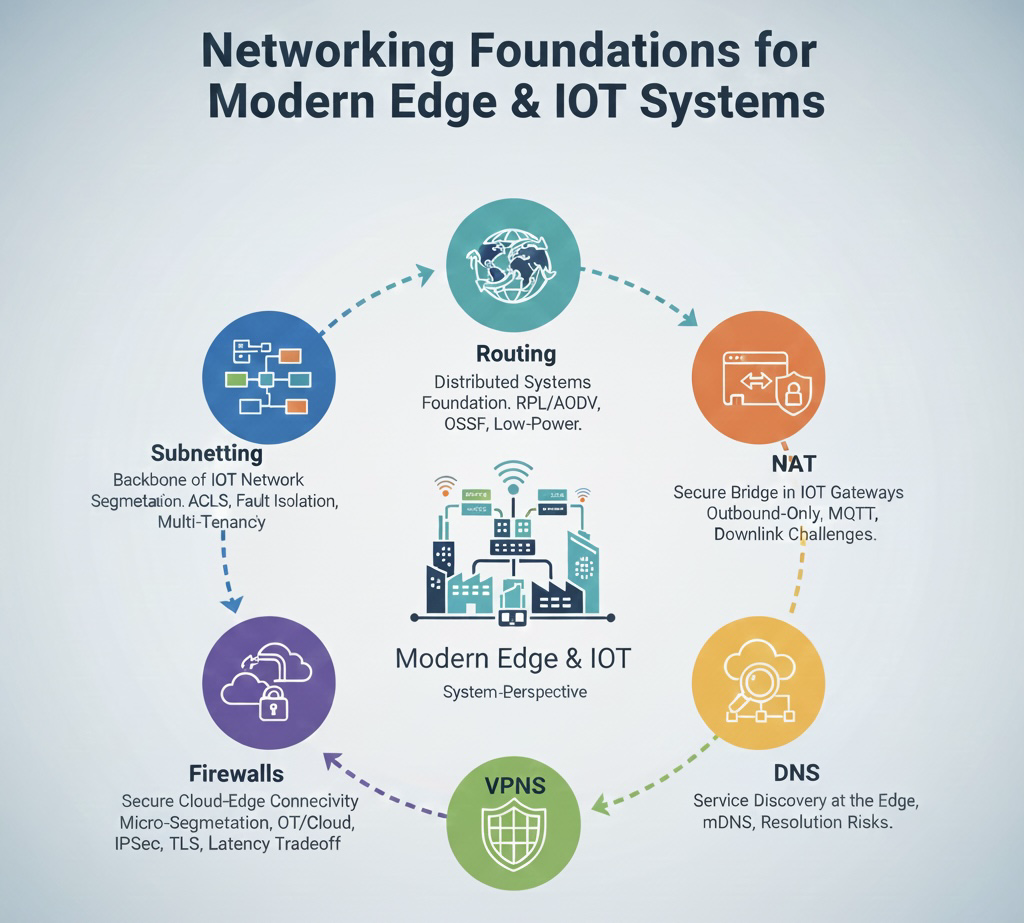
Even though networking fundamentals are often taught at the early stages of a tech career, their relevance becomes far more important when you begin working with distributed IoT and edge-driven architectures. Concepts like subnetting, routing, NAT, DNS, firewalls, and VPNs evolve from simple textbook ideas into core architectural tools that determine how devices communicate, how secure the system remains, and how reliably data moves between the edge and the cloud.
This refresher looks at these fundamentals from the perspective of someone building and supporting real IoT and edge environments. The goal is not to re-teach the basics, but to reconnect them with the realities of large-scale, low-power, and cloud-connected systems.
- Subnetting as the Backbone of IoT Network Segmentation
Subnetting plays a much bigger role in IoT and edge-driven environments than most people realize. In traditional networking, subnets help organize traffic and reduce broadcast noise. In IoT, they become a core part of the system architecture. When you’re dealing with sensors, gateways, and edge compute nodes running side by side, the network must be segmented in a way that keeps each function secure and predictable.
A typical LoRaWAN setup shows this clearly. The gateway LAN, the packet-forwarder network, and the edge analytics node usually sit in different subnets. This separation allows you to apply strict ACLs around what each component can communicate with, especially because IoT devices often have limited security controls of their own. Subnetting also helps manage traffic flow, ensuring that noisy sensor broadcasts don’t interfere with time-sensitive edge workloads.
Beyond security, good subnet design improves fault isolation. If a node misbehaves, the impact is contained within its segment. This structure also supports multi-tenant IoT deployments, where different applications or departments share the same physical infrastructure without touching each other’s data paths. In short, subnetting evolves from a basic networking concept into an essential tool for building reliable and secure IoT systems.
- Routing in IoT and Edge Systems
Routing takes on a different level of importance once you step into IoT and edge computing. In traditional IT networks, routing is mostly about forwarding packets efficiently. In IoT, routing becomes the foundation that keeps large, distributed, and often resource-constrained systems functioning. Whether you are working with LoRa mesh networks, Zigbee clusters, Thread, or 6LoWPAN environments, routing determines how devices communicate, how far messages travel, and how resilient the system remains when nodes fail.
Enterprise backhaul networks may use OSPF to maintain stable paths between gateways, but inside the IoT domain, lighter routing protocols such as RPL, AODV, and DSR dominate because they reduce overhead on low-power devices. These protocols help sensors create multi-hop paths so they can reach gateways even when they are out of direct range. This becomes especially important in agriculture, energy, or industrial settings where devices are spread over large areas.
Routing also affects system latency. A poorly designed routing structure can introduce delays that break real-time operations, such as microgrid fault detection or robotics control. Understanding routing at both the enterprise and IoT levels helps you design networks that are stable, predictable, and capable of supporting edge workloads without interruption.
- NAT in IoT Gateways and Secure Data Flow
NAT plays a quiet but critical role in IoT deployments. Most IoT devices are never meant to sit directly on the public internet, and even if they could, their limited security features make it unsafe. Instead, gateways act as the bridge between private sensor networks and cloud platforms, translating internal traffic to a public IP through NAT. This allows hundreds or thousands of devices to communicate safely without being exposed individually.
A common example is a LoRaWAN deployment. The packet forwarder running on a gateway almost always sits behind NAT. It sends uplink messages to the network server—whether that’s The Things Stack, ChirpStack, or a custom platform—using outbound-only communication. This design keeps devices and gateways protected from unsolicited inbound traffic. NAT also affects the behavior of protocols like MQTT, where the device or gateway initiates the session to avoid inbound challenges.
However, NAT is not without limitations. It can complicate downlink operations or remote management, especially when the cloud needs to push commands back into the network. In some IoT environments, this delay becomes noticeable. Understanding how NAT behaves in large-scale IoT systems helps engineers design secure, reliable paths between sensors, gateways, and cloud services without opening unnecessary attack surfaces.
- DNS and Service Discovery at the Edge
DNS is often treated as a simple lookup mechanism, but in edge computing and IoT, it becomes an essential part of the control plane. As devices, gateways, and microservices multiply across a distributed environment, the system needs a reliable way to discover services, resolve endpoints, and route workloads between the cloud and edge layers. DNS provides that foundation.
Modern edge platforms such as K3s, KubeEdge, and Greengrass rely heavily on DNS-based discovery to connect functions running on edge nodes to services running in the cloud. Even lightweight environments use variations like mDNS to allow devices to find each other locally without centralized infrastructure. This becomes especially useful in constrained networks where cloud connectivity is intermittent.
But DNS also comes with risks. Spoofing, cache poisoning, and misconfigured zones can disrupt IoT operations or redirect traffic to malicious endpoints. In real-time systems such as microgrids or industrial controllers, even small delays in DNS resolution can affect decision-making at the edge. That’s why DNS hardening—both in the cloud and at the edge—is crucial. Understanding DNS beyond the basics helps you design IoT systems that remain discoverable, resilient, and secure as they scale across distributed environments.
- Firewalls and Zero Trust in IoT Networks
Firewalls play a much more strategic role in IoT systems than in traditional IT networks. Because IoT devices often come with limited built-in security, the responsibility shifts to the network to enforce strong boundaries. Micro-segmentation becomes essential. Each class of device—sensors, actuators, gateways, edge servers—should sit behind dedicated rules that control exactly what they can communicate with.
IoT deployments in industrial or energy settings often mix operational technology with cloud services. In these environments, firewalls act as the guardrails that separate critical equipment from regular network traffic. They help prevent replay attacks, injection attempts, or unauthorized commands targeting low-power devices that cannot defend themselves. Systems like AWS Greengrass apply firewall-like controls directly on edge nodes to decide which services can run locally and which must reach the cloud.
East-west inspection is also becoming important as more workloads run at the edge. Even within the same subnet, devices should not freely communicate unless the relationship is intentional. This supports a Zero Trust architecture, which is increasingly necessary in IoT systems that span farms, factories, energy grids, and smart cities. Strong firewall design keeps the network protected even when devices are deployed in harsh, unmonitored environments.
- VPNs for Secure Cloud-Edge Connectivity
VPNs are the backbone of secure communication in IoT and edge computing environments. Since many deployments rely on remote gateways scattered across cities, farms, or industrial sites, the network must provide a trusted path back to the cloud. VPNs create encrypted tunnels that protect data traveling between edge nodes and central platforms, ensuring confidentiality even when operating over public networks.
A common example is the IPSec tunnels used by LoRa gateways to connect to network servers. These tunnels ensure that sensitive sensor data is shielded from interception as it moves from the field to cloud services like The Things Stack or Azure IoT Hub. VPNs are also used for remote administration, allowing engineers to manage gateways, sensors, and edge devices without exposing them directly to the internet.
For constrained devices, full IPSec tunnels may be too heavy, so TLS-based lightweight VPNs are used instead. These approaches still provide strong protection but with less overhead. However, VPNs do introduce latency, and in real-time environments like microgrids, robotics, or industrial automation, this delay must be carefully managed. Understanding how VPNs interact with bandwidth, latency, and encryption helps build edge architectures that maintain both performance and security across distributed deployments.
Conclusion
As edge computing and IoT continue to expand into every industry, the fundamentals of networking become even more important. Subnetting, routing, NAT, DNS, firewalls, and VPNs may look like basic concepts on paper, but in practice they shape how modern distributed systems operate, communicate, and stay secure. When these foundations are applied with an IoT and edge mindset, they transform into the building blocks that support large-scale deployments, real-time analytics, and resilient cloud-connected architectures. Mastering these basics with a deeper, system-level perspective ensures that any engineer working in this space remains effective, relevant, and prepared for the next phase of technological growth.