Amazon S3 makes you realize that it is less about storage in the traditional sense and more about how modern systems think about data. At a basic level, S3 is simple. You put objects in buckets and retrieve them when needed. But once you look at it through an IoT lens, it becomes clear why S3 shows up so often in real deployments. IoT systems generate data continuously, often in small bursts, from devices that may be unreliable, battery powered, or deployed in remote locations. S3 fits naturally into this pattern because it does not expect structure upfront and it does not require constant interaction once data is written.
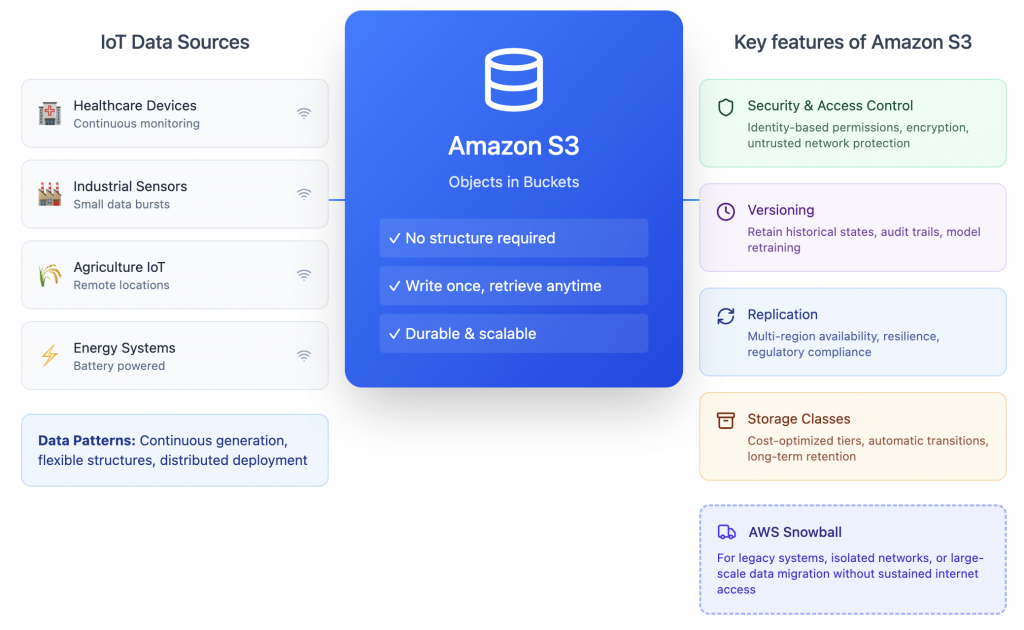
From a security perspective, S3 also aligns well with how IoT systems are designed. IoT data is usually sensitive, whether it comes from sensors in agriculture, energy systems, healthcare devices, or industrial monitoring. Being able to tightly control who can write data, who can read it, and under what conditions matters a lot. S3’s permission model, encryption options, and integration with identity based access control make it practical to store device data without exposing it broadly. It feels designed for environments where you assume the network is not always trusted and access must be explicit.
Versioning is another feature that seems minor until you think about IoT workflows. Data from devices can be noisy, duplicated, or corrected later through processing pipelines. Having built in versioning means you can retain historical states of objects without building custom logic. This is especially useful when raw sensor data is kept for auditing, retraining models, or debugging anomalies long after the data was first ingested. In many IoT systems, yesterday’s data can become important months later.
Replication and storage classes also map cleanly to real IoT constraints. Data collected at the edge may need to be available in different regions for analytics, resilience, or regulatory reasons. S3 replication removes much of the operational burden from that process. At the same time, not all IoT data needs to live in fast, expensive storage forever. Being able to transition older data into lower cost storage classes without changing how applications access it makes long term data retention realistic, even at scale.
Even services like Snowball start to make sense when you think beyond cloud first assumptions. Large scale IoT deployments sometimes begin with legacy systems, isolated networks, or environments with limited connectivity. Having a way to move large volumes of device data into S3 without relying on sustained internet access is practical, not theoretical.
Understanding S3 through the view of IoT highlights why it has become such a foundational service. It does not try to dictate how data should look or how it should be processed. Instead, it provides durable, secure, and flexible storage that fits naturally into distributed, device driven systems. For IoT workloads, that flexibility is often more important than any single feature.